Amplemarket — Research Intelligence
Amplemarket helps sales teams discover new prospects through buying signals, but its AI stopped at prospecting. I led the design of Research Intelligence, which extended that signal model to accounts reps already owned, and defined how its findings were presented: what reps saw first, how much they could trust it, and when it was out of date.
The problem
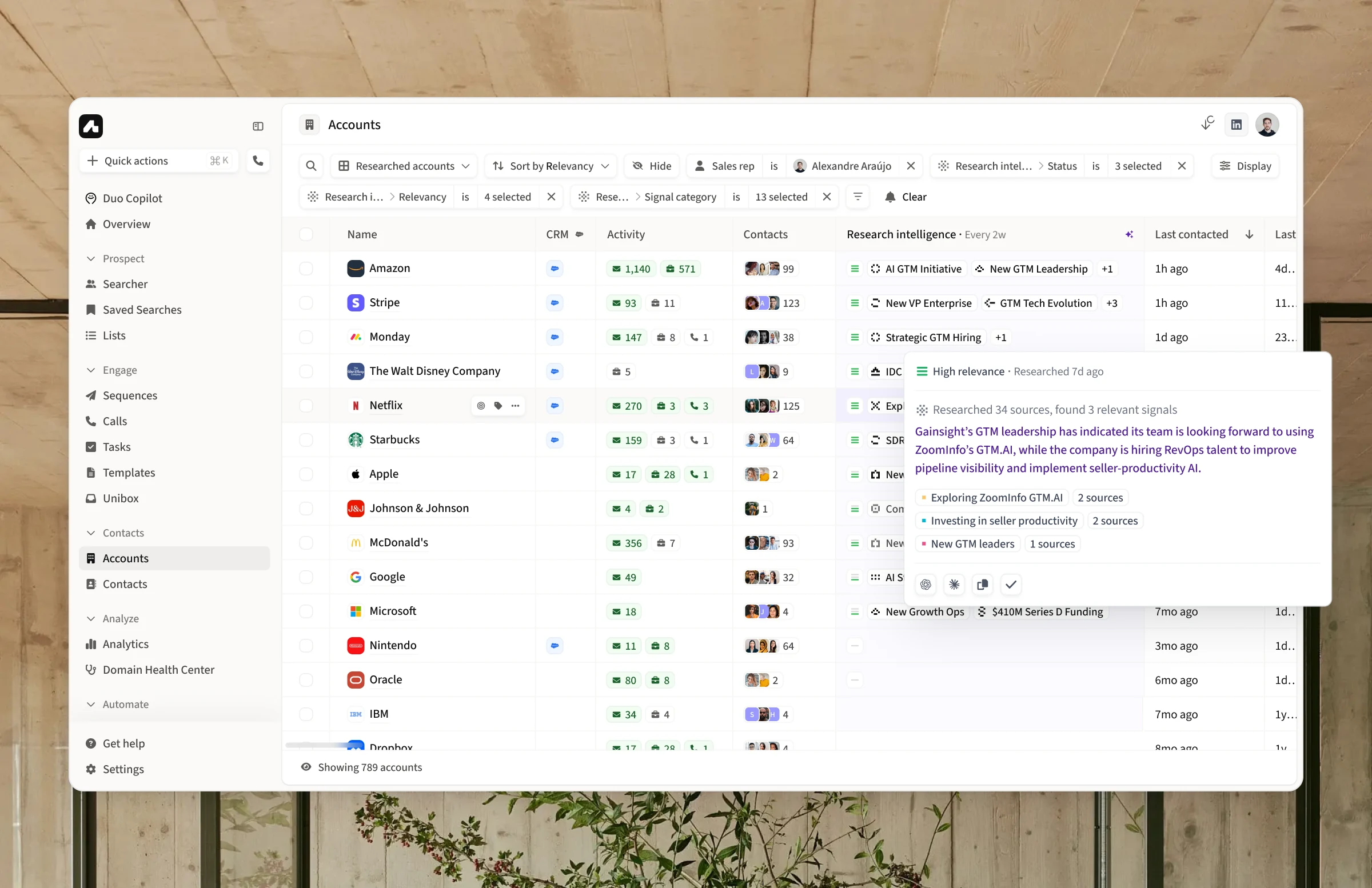
Before contacting an account, reps checked its website, LinkedIn page, and recent news for something relevant to mention. They repeated that research account by account.
Amplemarket's Duo Copilot surfaced buying signals for new prospects, but nothing comparable existed for accounts already in a rep's CRM or workspace, where reps already had relationships and history. The opportunity was to automate that research and turn it into a prioritization input: which accounts to revisit, and why now.
The solution
Research Intelligence is an agent that reviews every account in a rep's CRM or workspace every two weeks and brings back what changed: funding rounds, leadership moves, hiring, expansion. It collected far more than reps needed, so the design work was deciding what a rep should see, believe, and do with it.
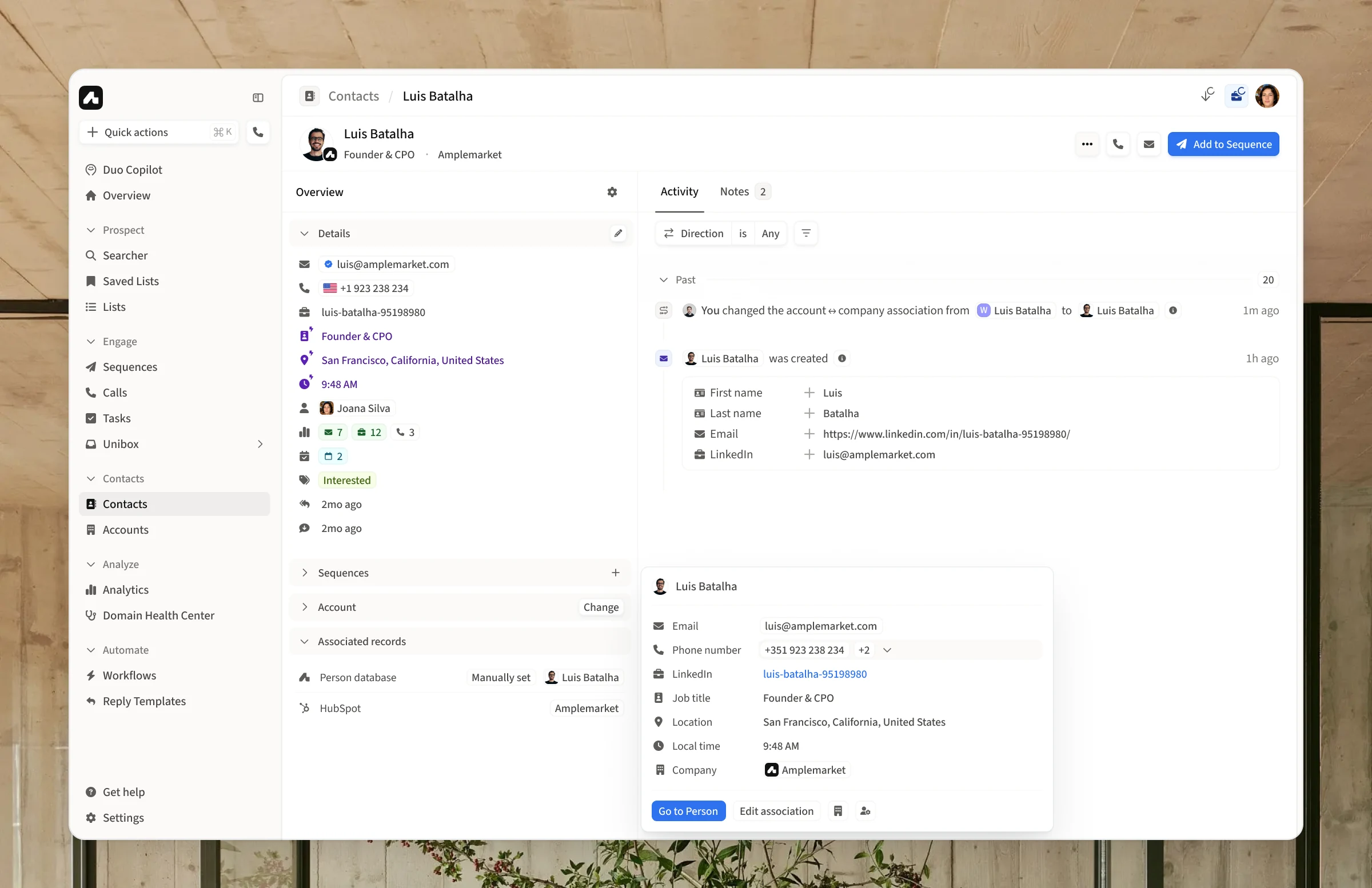
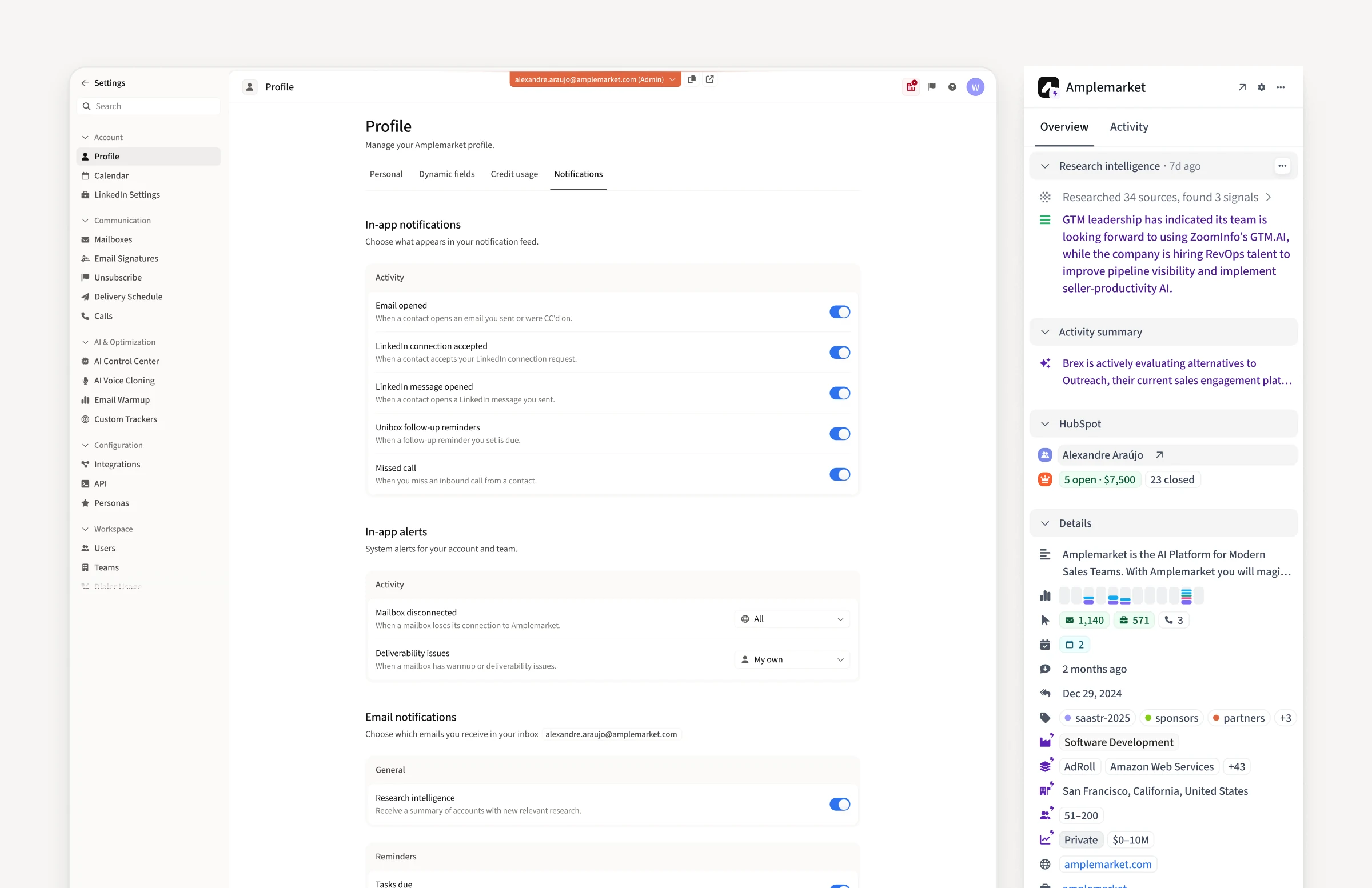
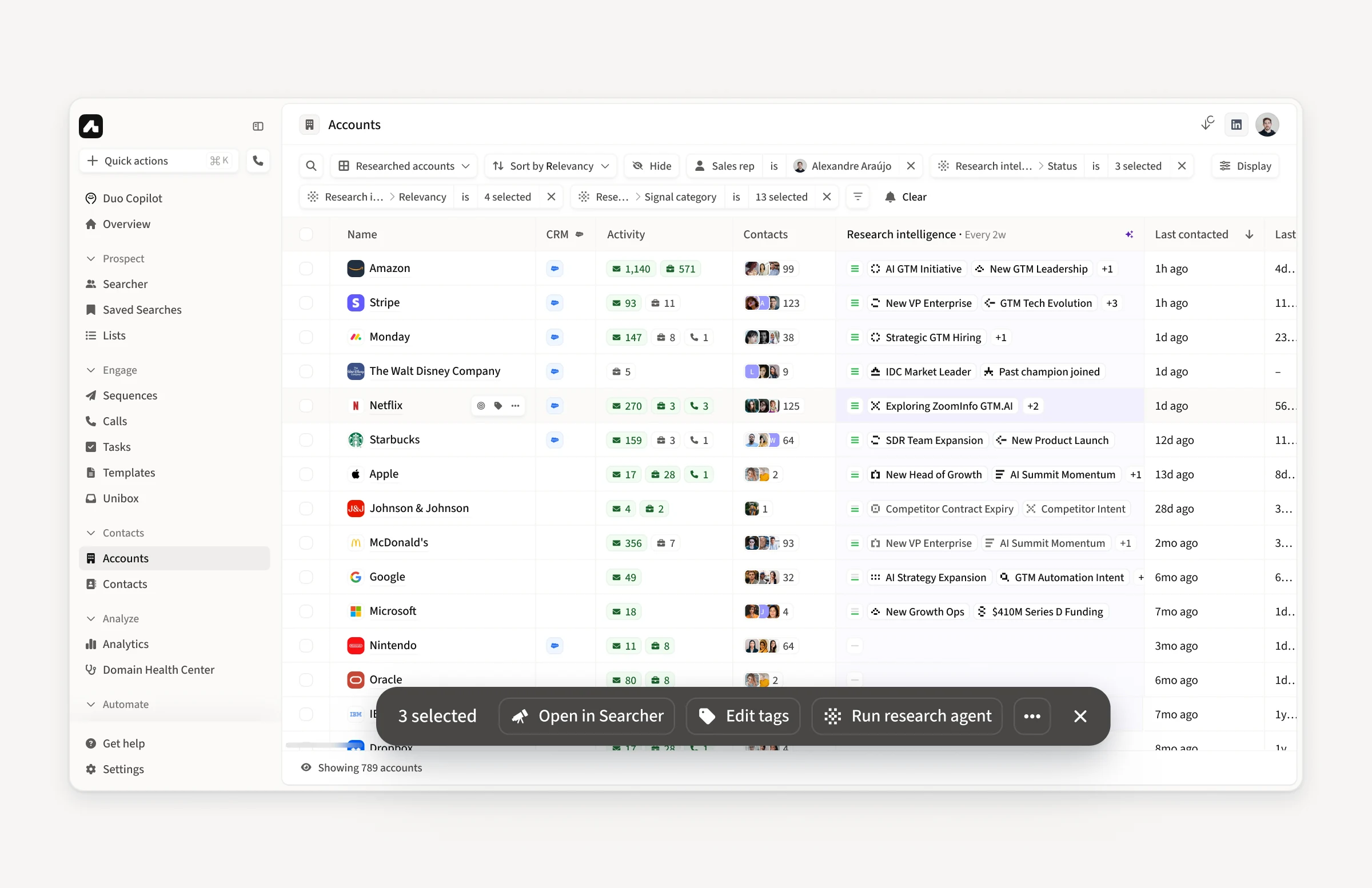
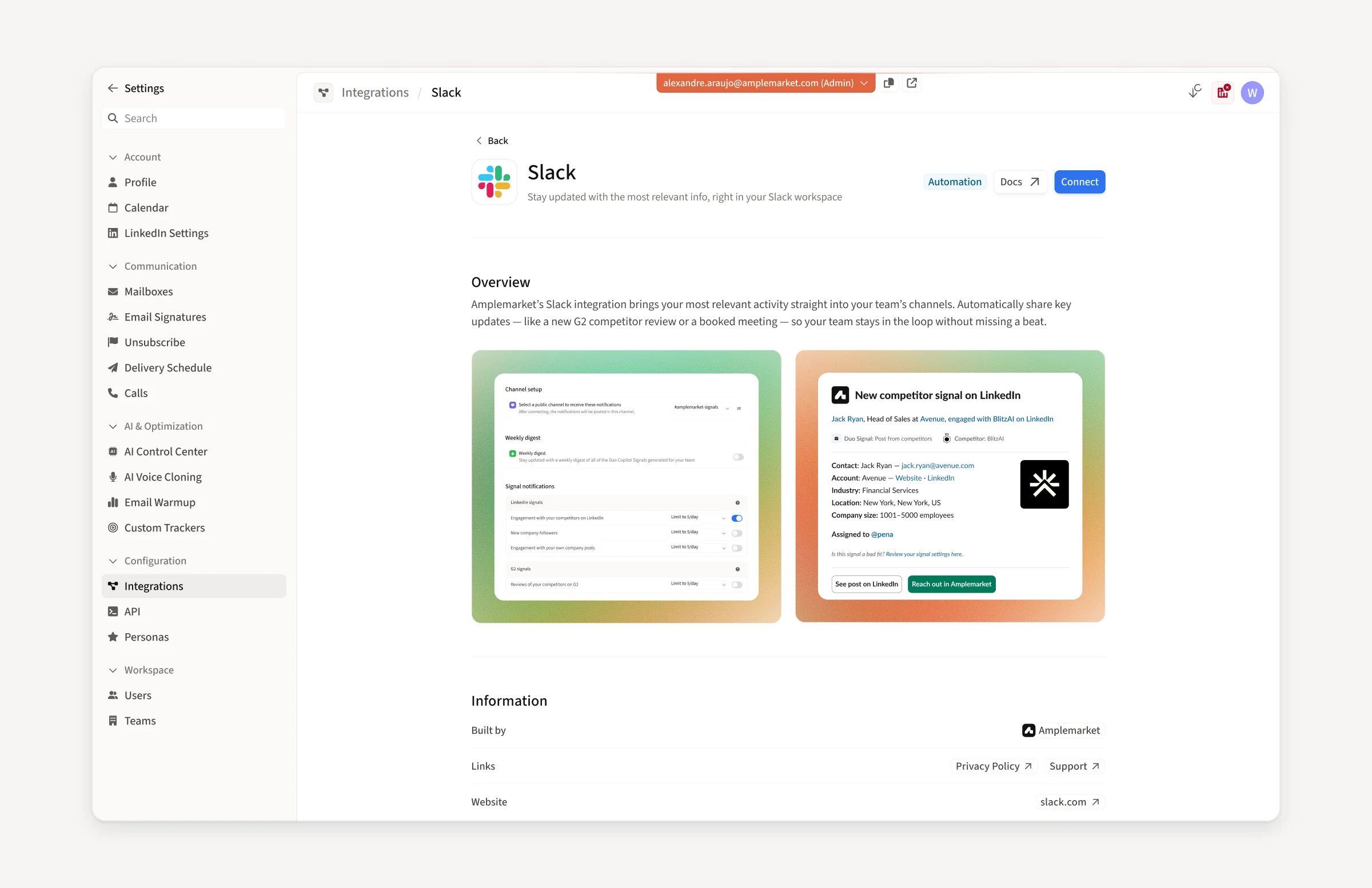
Findings arrive as signals inside the account table and overview, the views reps already use to plan their week. Each signal carries a type, a confidence level, a short summary, its sources, and two dates: when the event happened and when the agent last checked. The same signal follows reps into contact views, the Chrome extension, bulk actions, and Slack and email notifications.
The sections below cover the tensions that shaped it and the decisions behind it.
The constraints
Three tensions shaped the work.
Attention. The account page already split space between company information, AI summaries, and configurable tables, so research had to be visible without becoming noise.
Identity. Research Intelligence served existing accounts while Duo found new prospects. Should it feel like a new capability or an extension of Duo? The answer would shape how customers understood Amplemarket's AI as a whole.
Trust. Findings could be wrong, outdated, or absent, and reps would repeat them to customers. Each finding's reliability had to be legible on every surface where it appeared.
Each tension led to one of the decisions below.
Decision 1
Build research into accounts instead of launching a new sub-product
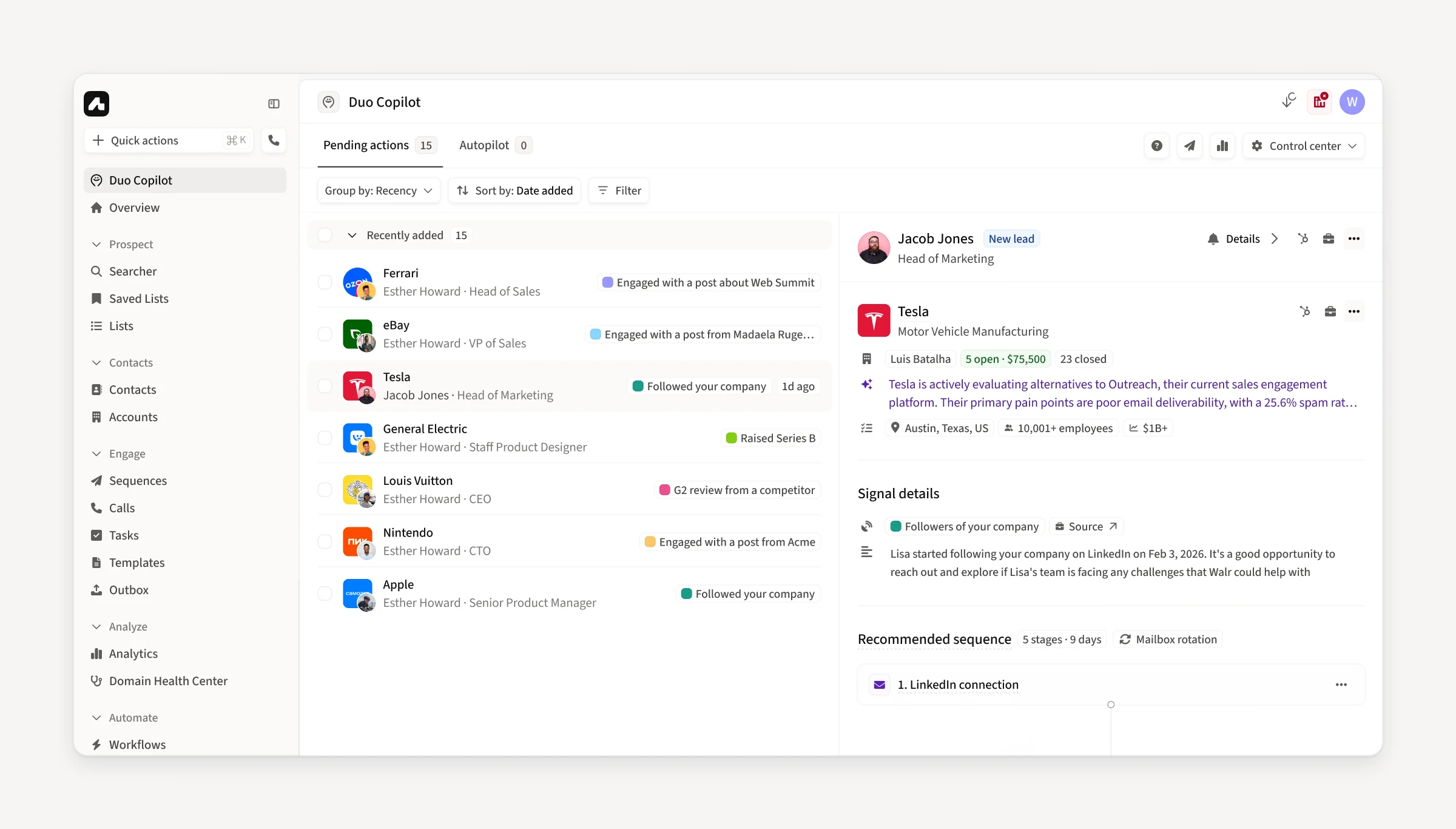
The obvious way to launch was as a new sub-product. Duo Copilot already had its own place in the sidebar, its own queue, and a clear identity. Research Intelligence could mirror it: a page listing every account where the agent found something, for reps to work through.
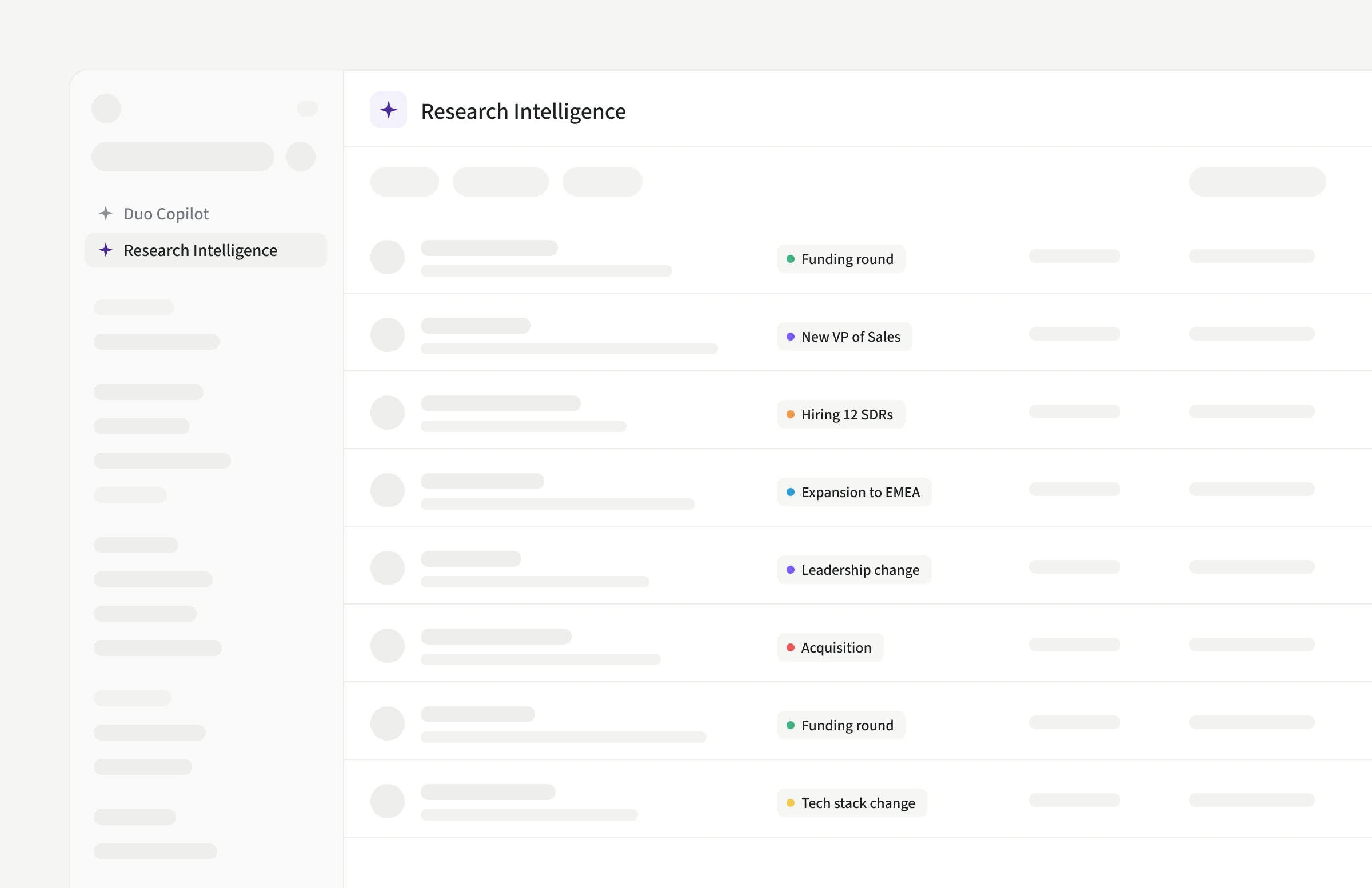
I explored that direction and argued against it. A sub-product would make research a destination. Reps would have to remember to open it before knowing whether anything had changed, then carry what they found back to the accounts they were already working. It would also split an account's story across two places. Research was only valuable if it changed priorities while reps reviewed accounts, so signals belonged in the account table and overview.
A dedicated Signals tab on the account page failed the same way at a smaller scale: it still waited to be opened.
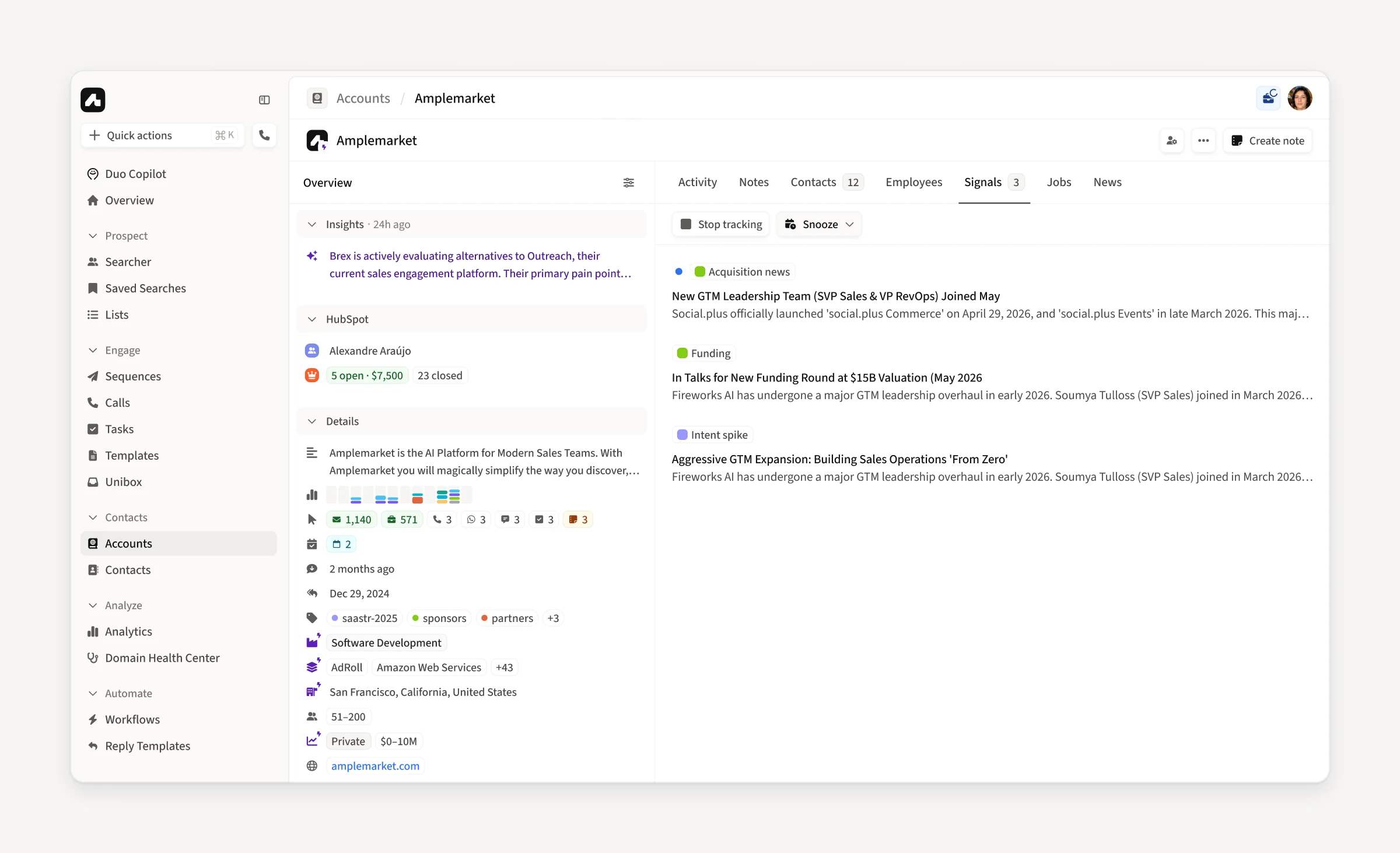
I gave each surface one question to answer. The table answered which accounts deserved attention, through a compact indicator and filtering and sorting by signal strength, count, and type. The overview answered what changed and why, holding the explanation and evidence.
That division mattered most when an account had several findings, such as a funding round, a leadership change, and hiring activity. Instead of compressing them into one table cell, the overview presented them together, each with its own explanation and evidence, so reps could judge how they related.
Decision 2
Align with Duo, and surface the larger AI identity question
My early explorations gave Research Intelligence its own identity, including pixel-style icons for each signal type, to mark its different purpose.
Customer conversations showed that the distinction mattered more to us than to users. Reps saw both as signals that informed their next move, and a second visual system would add a concept to learn without adding meaning. I dropped my own direction and moved to Duo's signal language, letting context and placement carry the difference in purpose.
The decision exposed a broader issue, which I took to the founding team: Amplemarket was shipping AI capabilities faster than it had a coherent way to present them. We aligned signals for this release and treated the wider AI branding as separate work.
Decision 3
Make the agent's reasoning inspectable
A rep who repeats an AI finding to a customer is staking their credibility on it. Every signal needed to answer two questions: why does this account matter now, and can I trust this? I designed a progression that let reps stop at the depth they needed:
- A compact indicator
- An AI-generated summary
- Research details: when the research ran, how many sources were analyzed, and which signals were identified
- Links to the original sources
This went beyond presentation. With product and engineering, I shaped the agent's output itself: a three-level confidence model, what reps should infer from each level, and four distinctions the raw output blurred:
- Fact vs. inference. The agent might read a new office as entry into a new market. Summaries separated what a source reported from the opportunity the agent inferred, with the source beside both.
- Evidence vs. relevance. Confidence described evidence quality only. A directly sourced announcement earned more confidence than an ambiguous mention, and a verified event could still be irrelevant to a rep.
- Event date vs. research date. With research every two weeks, a finding could be accurate but no longer timely. Each finding showed when the event happened and when the agent last checked, keeping confidence separate from age.
- No findings vs. no research. “No relevant changes found,” “Research pending,” and failed runs each had their own state, so an empty result never implied that nothing had changed.

Together, these let reps evaluate a finding before using it, instead of trusting or ignoring the agent wholesale.
One signal model across surfaces
Instead of designing each surface separately, I defined one signal model (type, confidence, summary, evidence, and dates) and set how much of it each surface carried: contact views, the Chrome extension, bulk actions, and Slack and email notifications. The flow stayed constant: notice a signal, understand the change, inspect the evidence, decide whether to re-engage.

Outcome
Research Intelligence launched in September 2026, extending Amplemarket's signal model from prospecting to existing accounts. Aligning with Duo kept the product's AI to one signal language instead of two.
The most useful part was finding a reason to reopen accounts that had gone quiet. I could check the sources and use that context to prepare my outreach. That’s research I’d normally piece together myself. I’d use this to decide which accounts to revisit each week.
The launch is too recent to show an effect on meetings or pipeline. The next question is whether reps keep finding these insights useful in their weekly workflow, and whether viewed signals lead to account engagement.
Reflection
The most consequential decision was treating research as an input to prioritization rather than a destination. It determined where signals appeared, how much they showed first, and how they supported a rep's next decision.
The broader lesson: AI features need a shared model for confidence and freshness, not feature-by-feature answers. In another iteration, I'd close the gap between understanding a signal and acting on it. A strong signal still left reps to find the right contact on their own.